Example: a community articleContent line, simplified · Sample data
- 1StationIntakeThe orchestrator records the brief and checks the source.Talk → article
- 2StationCaptureA research agent pulls what the talk says, with sources.
- 3StationDraftThe community writer drafts the piece from the brief.
- RReviewEvaluateA separate reviewer scores it and runs six checks. It never rewrites.
- HA person decidesPublish or returnThe editor reads the package and approves, returns or escalates.
If the review fails, the piece goes back to the writer with notes. After two failed rounds it stops looping and goes to a person.
The words we use
How a line works
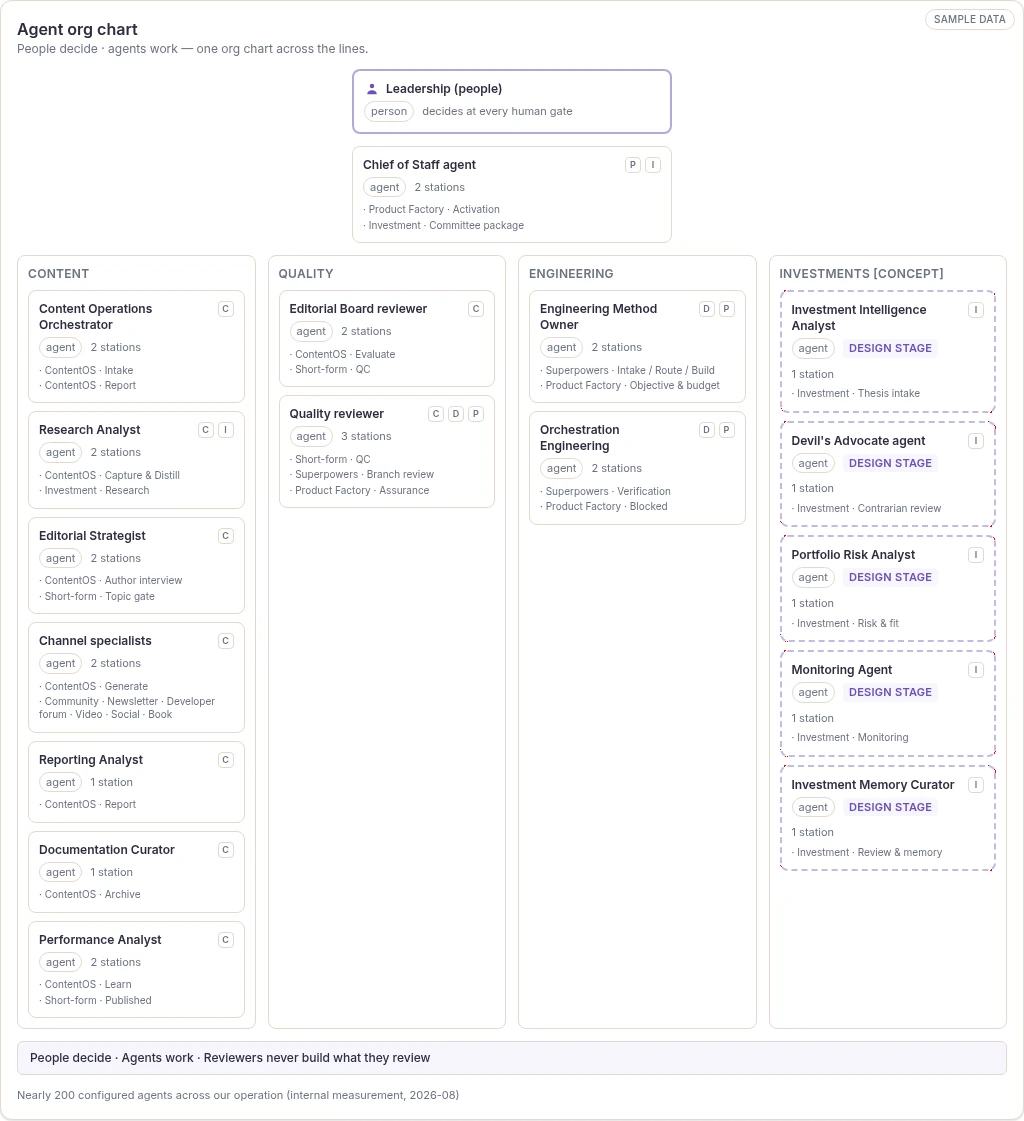
A pipeline is a map of stages, and each stage has a fixed list of exits. A working stage is a station: one agent, its skills and one instruction. Someone who did not build the work holds each decision stage, and a person holds the final call on every line. A small watcher with no AI in it makes sure nobody waits on a message that was never sent.
- Case
- One unit of work: a content piece, a feature, a product run or an investment thesis.
- Stage
- A named step with a fixed list of allowed exits. The system refuses any move outside the map.
- Station
- A working stage bound to exactly one agent, a curated set of skills and an instruction for that stage. When a case arrives, the agent wakes up with that instruction.
- Who moves the case
- The agent of the stage, once it has delivered. Closing a task never moves a case on its own.
- Decision gate
- The agent writes a decision package and stops. An approver who did not build the work approves it or sends it back. Each line sets who holds each gate.
- Human gate
- A decision gate held by a person. No agent can move it.
- Human input
- A working stage that waits for a person's answer, such as the author's interview. Nobody approves anything there, and the agent never makes up the missing answer.
- Independent review
- The reviewer is a different agent from the maker. It judges and never rewrites. A check it cannot measure counts as a fail.
- Bounded loops
- Revision rounds stop at two. The third failure goes to a person.
- Closed intake
- A case with a missing input does not get in. The agent lists what is missing and stops.
- Alarm clock
- A plain script, with no AI, that checks every 15 minutes. When a blocked task's dependencies are done and nobody said so, it posts DELIVERED or RELEASED. Prompts forget. The script doesn't.
- Evidence trail
- Every station closes its task with a comment and the path to what it made. Final deliverables are attached to the case as documents.